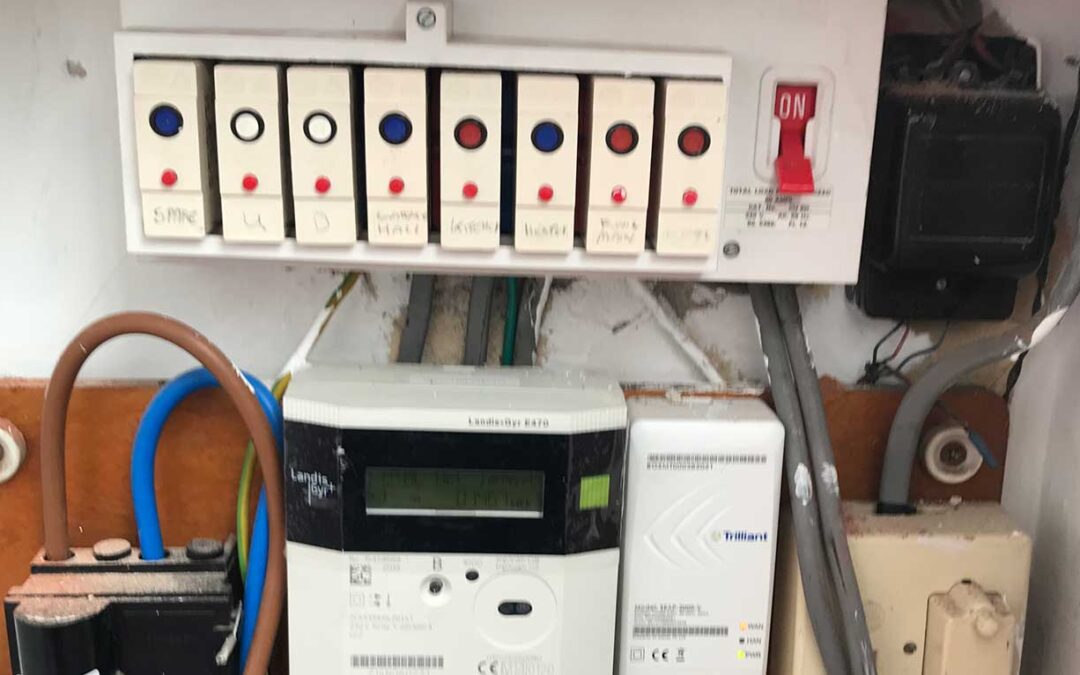
A consumer unit, often called a fuse box or fuse board, is the central point where electricity is distributed to different circuits throughout your property. It contains protective devices designed to disconnect the electricity when certain electrical faults occur.
Understanding how your consumer unit works can help you recognise potential safety concerns, identify outdated equipment and know when to seek professional advice.
What Does a Consumer Unit Do?
A consumer unit distributes electricity from your property’s incoming supply to individual circuits, such as those supplying lighting, sockets, cookers and electric showers.
Its main purpose is to provide a central location for circuit protection and isolation.
A modern consumer unit typically performs three essential functions:
- Electricity distribution: Supplies power to separate circuits throughout the property.
- Fault protection: Disconnects affected circuits when protective devices detect certain faults.
- Electrical isolation: Allows circuits, or the installation as a whole, to be switched off when necessary.
Without appropriate circuit protection, electrical faults can increase the risk of electric shock, overheating and fire.
What Is Inside a Modern Consumer Unit?
Modern consumer units contain several electrical components, each with a specific function.
Main Switch
The main switch allows the electricity supply to the circuits controlled by the consumer unit to be isolated. This is useful during maintenance or an electrical emergency.
Miniature Circuit Breakers (MCBs)
MCBs protect individual circuits against overloads and short circuits.
For example, if too many appliances overload a socket circuit, the circuit breaker may trip to prevent excessive current from continuing to flow.
Residual Current Devices (RCDs)
RCDs monitor the balance of electrical current flowing through a circuit and disconnect the supply when they detect an imbalance above their operating threshold.
They provide important additional protection against electric shock and certain electrical faults.
Residual Current Breakers With Overcurrent Protection (RCBOs)
RCBOs combine the functions of an RCD and an MCB in one device.
They provide both residual current protection and overload or short-circuit protection for an individual circuit.
Surge Protection Devices (SPDs)
SPDs help protect electrical installations and connected equipment against transient overvoltages, including those caused by switching events or lightning-related surges.
Not every consumer unit contains identical components. The arrangement depends on the installation’s age, design and applicable requirements.
What Is the Difference Between a Fuse Box & a Consumer Unit?
The terms are often used interchangeably, but there are important differences between older fuse boxes and modern consumer units.
An older fuse box is not automatically unsafe simply because of its age. Its condition, protective arrangements and suitability must be assessed by a competent electrician.
Older Fuse Box
- May use replaceable fuse wire or cartridge fuses
- May have limited additional shock protection
- May have older enclosure designs
- May not include surge protection
Modern Consumer Unit
- Generally uses resettable circuit breakers
- Typically incorporates RCD or RCBO protection
- New domestic units are generally required to have non-combustible enclosures
- Can incorporate surge protection where required

How Do You Know If Your Consumer Unit Needs Replacing?
Consumer units do not have a universal replacement date. Whether an upgrade is necessary depends on the installation’s condition, safety and suitability.
Common reasons to arrange an electrical assessment include:
- Frequent circuit breaker or RCD tripping.
- Visible damage, scorching or signs of overheating.
- An old fuse box with limited protective devices.
- A burning smell or unusual buzzing from the unit.
- Electrical alterations that require additional circuit capacity.
- An Electrical Installation Condition Report (EICR) identifying relevant safety concerns.
A consumer unit does not necessarily need replacing because it lacks every feature found in a new installation.
Important: If you notice smoke, burning smells or visible overheating, avoid touching the equipment and seek urgent professional assistance.
Can You Replace a Consumer Unit Yourself?
Consumer unit replacement should be carried out by a suitably qualified and competent electrician.
The work involves more than connecting a new distribution board. It requires assessment of the existing installation, appropriate protective devices, safe isolation, electrical testing and certification.
In England, replacing a consumer unit in a dwelling is notifiable work under Part P of the Building Regulations.
A registered competent person can generally self-certify qualifying work through an authorised scheme.
For further information, see the UK Government’s guidance on electrical safety in dwellings.
Common Questions About Consumer Units
What Is a Consumer Unit in Simple Terms?
A consumer unit is the main electrical distribution and protection board in your home. It sends electricity to individual circuits and contains devices that disconnect the supply when certain faults occur.
Where Is a Consumer Unit Usually Located?
Common locations include hallways, cupboards, garages and utility rooms. Its position varies depending on the property’s layout and installation history.
How Long Does a Consumer Unit Last?
There is no fixed lifespan. Its serviceability depends on its condition, design, environment and continued suitability. Regular electrical inspections help identify potential problems.
Does a New Consumer Unit Mean My House Needs Rewiring?
No. Consumer unit replacement and house rewiring are separate jobs. However, the existing wiring must be assessed to establish whether it is suitable for connection to the new unit.
Understanding Your Consumer Unit & What to Do Next
Your consumer unit is an essential part of your home’s electrical safety system. Knowing what it does and recognising possible warning signs can help you make informed decisions about maintenance and upgrades.
If you’re uncertain about the condition of your fuse box, an electrical inspection can establish whether it remains suitable or needs attention.
At Mark Evans Electrical, we provide consumer unit installations and upgrades for homeowners across Bath and Bristol.
If you need advice from an experienced electrician in Bristol or Bath, contact our team or call 07770 233475 to discuss your concerns.